Building a Brand-Protection Program: 7-Step Framework
- Share
- publisher
- QSDEFENDER Brand Protection Advisory Team
- Issue Time
- Oct 30,2026
Summary
A manufacturer-grade 7-step framework for building a brand protection program: quantify SKU-level exposure, fix the legal and customs floor, choose physical and digital identity layers, engineer a label that survives the line, run server-side verdicts with clear key custody, connect supply-chain checkpoints and channel alerts, then operate a quarterly KPI loop. Includes the ISO 22383:2020 replacement for the withdrawn ISO 12931 and honest boundaries on what benchmarks can prove.
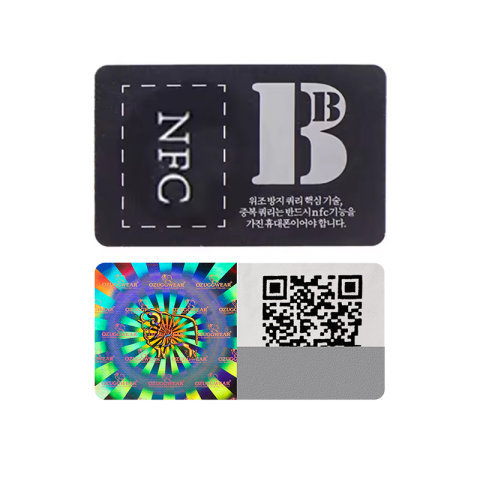
Most brands do not start a brand protection program framework because they want one. They start because a distributor is undercutting them by 40%, a customer posts a photo of a label that does not scan, or customs calls about a container nobody can account for. By then the response is usually reactive: one takedown, one new hologram, one legal letter. This guide lays out a seven-step framework that a mid-size manufacturer can actually run — with the deliverable, the owner, and the evidence each step must produce before the next one starts.
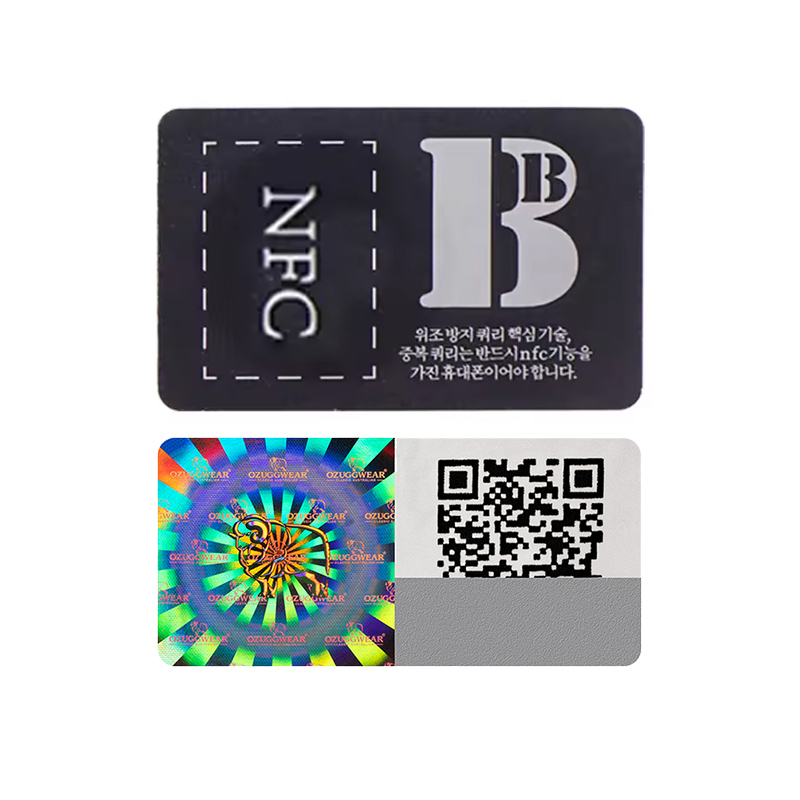
A program is a stack of decisions, not a catalogue order: each layer answers a different attack.
The 7-Step Brand Protection Program Framework at a Glance
A program differs from a project in one respect: it has an operating loop. Authentication technology is a component inside that loop, never the whole of it. The seven steps below are sequenced because each one constrains the next — if you pick a label before you know which SKUs lose money to fakes, you will buy the wrong label at the right price.
| Step | Question it answers | Deliverable | Typical owner |
|---|---|---|---|
| 1. Quantify exposure | Which SKUs, channels and markets actually lose money? | Ranked risk register with revenue at risk | Finance + brand |
| 2. Fix the legal floor | What can we enforce, and where? | Trademark coverage map, contract clauses, customs filings | Legal / IP counsel |
| 3. Choose the identity layer | How will a unit prove it is ours? | Layer specification: physical + digital | Brand protection + packaging |
| 4. Engineer the label | Will it survive our line and our customers? | Approved artwork, substrate and test report | Packaging engineering |
| 5. Build the verification chain | Who decides a scan is genuine, and how fast? | Server-side verdict logic, key custody plan | IT / security |
| 6. Connect supply chain and channel | Where do units change hands, and who sees it? | Checkpoint map, alert rules, evidence pack | Supply chain + sales ops |
| 7. Run the operating loop | Is it working, and what changes next quarter? | KPI dashboard, quarterly review, incident playbook | Program lead |
Step 1: Quantify Exposure Before You Buy Anything
Start with a risk register, not a supplier shortlist. For each SKU, score four inputs: unit price and margin, channel complexity (how many hands between factory and shelf), geographic exposure (where your product is copied or diverted today), and regulatory consequence (what happens if a fake injures someone). Multiply the first two to get an exposure weight, then rank.
The macro numbers justify the exercise but should never be used as your own estimate. The OECD and EUIPO joint report Mapping Global Trade in Fakes (2025 edition, based on 2021 customs data) put global counterfeit trade at USD 467 billion, or 2.3% of world imports, with the EU absorbing USD 117 billion — 4.7% of its imports, roughly double the global rate. Those figures describe the market, not your loss. Your loss has to come from your own returns, distributor complaints and test purchases.
- Output: a ranked list of no more than ten SKUs, each with an annual revenue-at-risk figure and a named owner.
- Gate: do not proceed for any SKU where the annual loss estimate is below roughly three times the projected label cost — that ratio is our working rule of thumb, not an industry standard.
- Common mistake: protecting the highest-priced SKU first. Copycats usually attack the fastest-moving mid-price item because volume, not margin, pays their tooling.
Step 2: Fix the Legal Floor First
Authentication without enforceable rights produces evidence you cannot use. Three items belong in this step:
- Trademark coverage in every market where the product is made, distributed or sold. Rights are territorial: an EU registration does nothing in China, the US or Brazil. The WIPO Madrid System lets one application designate many member states, which is usually cheaper than filing country by country.
- Contract terms that make technology operational. Territory definitions, receipt-scanning obligations, audit rights, penalty clauses and a clause stating who owns the serial data. A scan alert without a contractual consequence is a chart, not a control.
- Customs engagement. In the EU, rights holders file an application for action so customs can detain suspect consignments; in the US, CBP recordation plays the same role. Both require a product guide showing officers how to tell genuine from fake — ideally in the local language.
Standard-status check: if a supplier cites ISO 12931 as the basis for its authentication design, that standard was withdrawn in July 2021. It was replaced by ISO 22383:2020, which organises authentication elements into physical, material, digital and combined categories and explicitly excludes economic criteria — meaning the standard will not tell you whether a solution is worth its price. That judgement stays with you.
Step 3: Choose the Identity Layer
This is where most budgets are wasted, because the choice is usually made on unit cost alone. Decide by the verification moment: who scans, with what device, and what must the answer prove.
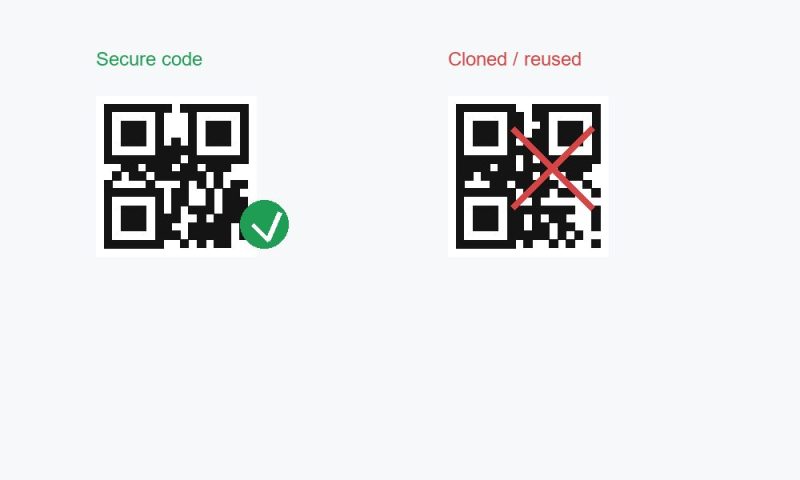
Serialization turns a label into an identity: the code is public, the record behind it is not.
| Layer | Verification moment | Strength | Watch out for |
|---|---|---|---|
| Serialized QR | Consumer phone scan, anywhere | Zero hardware cost, works on any packaging, easy to reprint | Copied codes look identical until the server sees a duplicate scan |
| NFC (e.g. NTAG 424 DNA) | Phone tap at close range | AES-128 authenticated URL that changes every tap; tamper loop option | Requires server-side validation; per-unit cost is higher than print |
| UHF RFID | Warehouse and logistics reads, metres away | Bulk reads without line of sight; case and pallet level | Not a consumer-facing proof; tag performance depends on the surface |
| Overt physical (hologram, VOID) | Human eye, no device | Immediate deterrence and visible tamper evidence | Deterrence only; a determined copier can imitate the look |
In practice a workable program combines at least two categories — a visible deterrent plus a serialized digital identity — which is the layered logic we describe in layered authentication. For a deeper comparison of frequency bands before you commit, see UHF vs HF vs NFC frequency choice.
Step 4: Engineer the Label to Survive the Line
The chip rarely fails first; the construction does. Four specifications decide whether the label still works after six months on a shelf:
- Print quality: module size, quiet zone and contrast determine whether a phone camera can read the code under warehouse lighting. Undersized modules are the single most common cause of a "dead" QR code.
- Substrate and adhesive: curved glass, low-surface-energy plastics and frozen cartons each need a different adhesive. A label that lifts at the edge is a tamper signal you did not intend.
- Application method: hand application, semi-automatic and high-speed line application impose different tolerances on die-cut spacing and liner strength.
- Durability tests: abrasion, humidity, temperature cycling and chemical wipe — run on the finished label on the finished pack, not on a sample sheet.
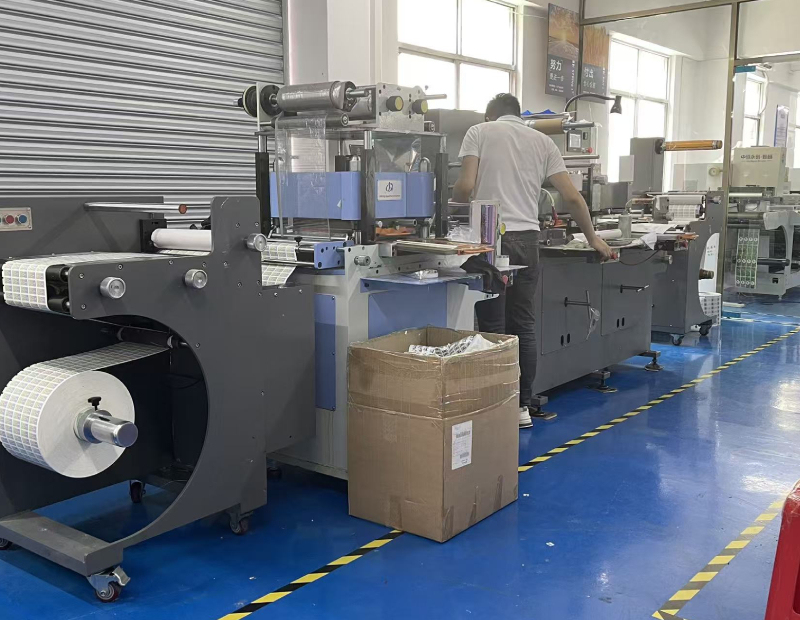
Print and die-cut tolerances are set on the line, not in the artwork file.
Print specification detail belongs in the artwork brief, and we cover it separately in the QR implementation playbook. If you are still comparing suppliers at this stage, the RFID and NFC buyer's guide lists the questions worth asking before a sample run.
Step 5: Build the Verification Chain Before You Print
A label is a claim; the server is the judge. Before the first production run, settle five decisions:
- Where the verdict lives. Genuine, already-scanned, unknown and tampered are four different answers, and each should route to a different message and a different internal alert.
- Key custody. For cryptographic tags such as NTAG 424 DNA, the AES keys can be held by you, by the label supplier, or split. Whoever holds them can mint identities; write the ownership and rotation rules into the contract.
- Replay detection. Dynamic URLs and read counters let the server distinguish a first scan from a copied code — provided the counter state is synchronised and monitored.
- Latency budget. A consumer will abandon a verification page that takes more than a few seconds. Treat the verdict response time as a product requirement, not an IT metric.
- Failure modes. Offline verification is not a thing for encrypted tags. Decide what the page says when the network is down, and never let it say "genuine" by default.
Step 6: Connect Supply Chain and Channel
Unit identity only becomes intelligence when it is read at handovers. Four checkpoints cover most diversion cases: factory dispatch, distributor receipt, retail receipt, and the consumer scan. Each read produces a timestamp, a location and a device identity; the gap between expected and actual is the signal.
Alert rules should be few and defensible: a scan outside the authorised territory, an outbound-to-inbound mismatch, inventory that exists in the system but not in the warehouse, a serial scanned in two countries within an hour, and an abnormal burst of scans from one device. We describe the rule set and the evidence package in RFID against gray-market diversion.
Step 7: Run the Operating Loop
Programs fail quietly: the labels ship, the dashboard goes unread, and nobody notices that scan rates collapsed after month three. Six indicators are enough to keep it honest.
| Indicator | What it tells you | Planning benchmark |
|---|---|---|
| Verification rate | Share of units scanned at least once | Category-dependent; track the trend, not the absolute |
| Duplicate-scan ratio | Share of serials scanned more than expected | A rising ratio is the earliest copy signal |
| Verdict distribution | Mix of genuine, duplicate, unknown, tampered | Unknown spikes usually mean a print or data error |
| Time to first detection | Days from counterfeit listing to internal alert | Shorter is better; set a target and review it quarterly |
| Enforcement latency | Hours from evidence pack to takedown request | Counterfeit sellers relist quickly; speed compounds |
| Revenue at risk | Exposure attached to open incidents | The number that justifies next year's budget |
Review quarterly, refresh the risk register annually, and after every significant incident ask one question: which step in this framework would have caught it earlier? That answer, not the incident itself, is what improves the program.
Where Programs Fail
Across the categories we work in — pharmaceuticals and supplements, wine and spirits, cosmetics, automotive parts — the same five failures recur. Buying a technology before defining the loss. Treating a takedown as a strategy. Choosing a label nobody on the line can apply at speed. Leaving key custody undefined. And measuring activity (labels printed, listings removed) instead of outcome (revenue protected). The framework above exists mainly to make those failures visible early.
Two boundaries worth stating plainly. First, this is operational guidance, not legal advice; customs filings, contracts and regulatory obligations need counsel in each jurisdiction. Second, the benchmarks in the tables are planning aids drawn from general practice, not guarantees, and no client data appears in this article.
Related Reading
- QR anti-counterfeit codes: 2026 implementation playbook
- RFID and NFC anti-counterfeiting labels: B2B buyer's guide
- Tamper-evident packaging for pharma and cosmetics
- Pharma serialization and DSCSA: what suppliers must deliver
- Anti-counterfeiting for wine and spirits
- Global counterfeiting statistics 2026: what the OECD data says
A working brand protection program framework is unglamorous: a ranked risk list, enforceable rights, a label that survives the line, a verdict the server can defend, and a quarterly review somebody actually attends. Build those seven steps in order and the technology decisions become obvious. If you want a second opinion on where your current setup sits, our team can walk the framework against your SKUs and report the gaps — request a program assessment.
Sources: OECD/EUIPO, Mapping Global Trade in Fakes (2025 edition, 2021 customs data); ISO 22383:2020 (published September 2020, supersedes ISO 12931:2012, withdrawn July 2021); WIPO Madrid System; EUIPO enforcement guidelines; EU Falsified Medicines Directive 2011/62/EU and Delegated Regulation 2016/161; U.S. DSCSA (2013) and 21 CFR 211.132. Standards and regulatory requirements are summarised here for orientation only; verify current status before relying on any of them. Written by the QSDEFENDER Brand Protection Advisory Team with AI assistance and reviewed against the primary sources cited above.