Hologram 101: Public, Covert & Forensic Layers
- Share
- publisher
- Fiona Mai
- Issue Time
- Oct 1,2026
Summary
A hologram security label is three protection tiers - public, covert and forensic. Learn what each layer does and how to stack them for anti-counterfeit defense.
Direct Answer: A Hologram Is Three Security Layers, Not One Trick
A hologram security label is not a single shiny effect. It is an engineered stack of at least three protection tiers: public (overt) features anyone can see, covert features hidden from the public but readable with a simple tool, and forensic features that survive even sophisticated cloning and need lab analysis to confirm. Each tier closes a different counterfeit path. This guide explains what each layer does, how they stack, and how to choose the mix for your product.
Key takeaway: Public holography scares off low-end fakes; covert features defeat visual replication; forensic marks provide evidence-grade proof. The three tiers protect each other, so cloning one does not defeat the label.
What a Hologram Security Label Actually Is
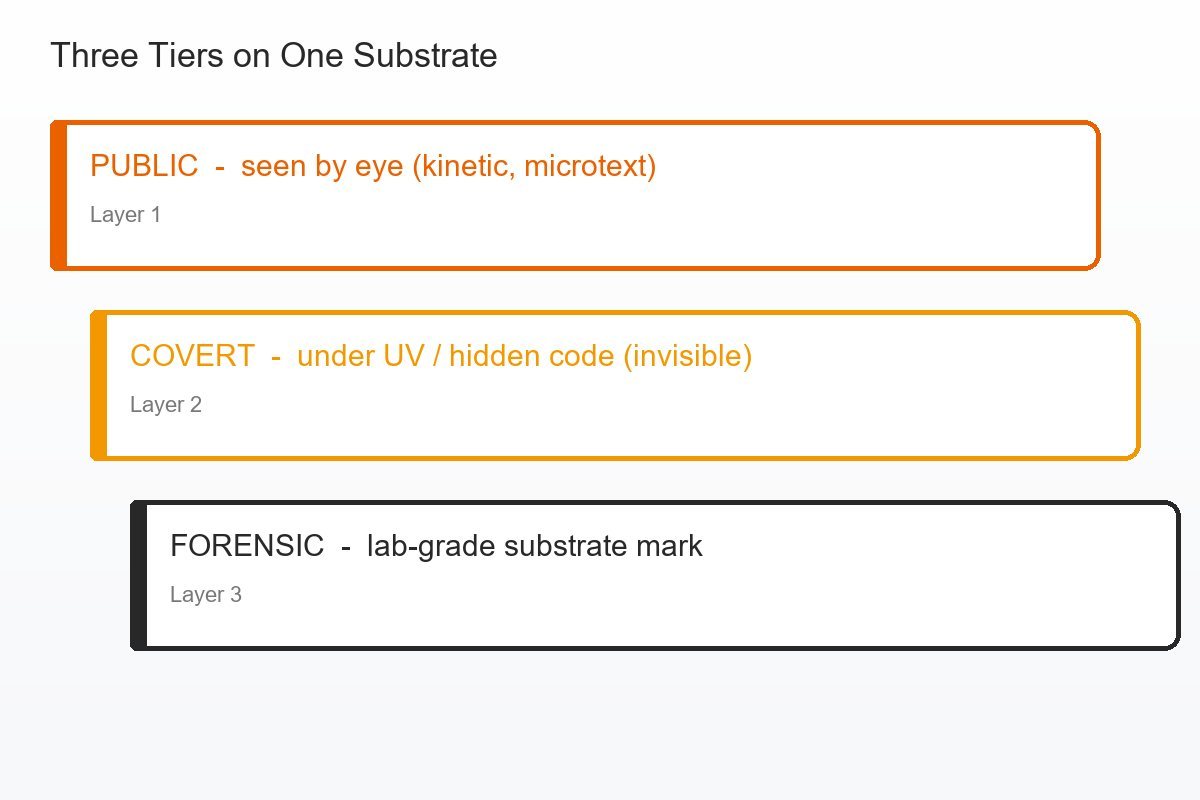
A modern security hologram is produced on a registered embossing or micro-optical production line. The visual "3D" effect is created by diffraction gratings and micro-structures, not by ink. That matters for security: the optical structure is hard to reproduce without the original master and tooling. Leading suppliers such as DXUNT (top-banded in China) build the protection around micro-optics plus hidden codes, pairing a visible optical effect with a concealed machine-readable mark for "physical plus digital" defense. The photo below shows a typical multi-tier label layout from our own optical line.
Layer 1 — Public (Overt) Features
These are the effects a buyer or inspector verifies by eye, with no tool required:
- Kinetic / 3D depth effects: images that shift, rotate, or appear to move as the label is tilted. Hard to photograph and reprint convincingly.
- Microtext and guilloché: fine lines and text that blur into a solid color when copied, exposing a fake instantly under magnification.
- Color-shift and true-color elements: areas that change hue at different viewing angles.
Purpose: instant, no-tool deterrence and a strong first impression of authenticity. Weakness: a capable counterfeiter with the right presses can reproduce convincing overt effects, which is exactly why overt is only your first line, never your only line.
Layer 2 — Covert Features
Covert features are invisible or nearly invisible to the public but readable with a low-cost tool or under specific light. They are the tier that defeats visual replication, because a cloner cannot copy what they cannot see:
- UV / fluorescent marks: patterns or codes that appear only under ultraviolet light.
- Micro-optical hidden codes: concealed machine-readable structures embedded in the hologram — the "hidden code" approach used in advanced micro-optics security. Readable by a scanner, invisible to the naked eye.
- Taggants and latent images: materials or images revealed only with a matching reader.
Purpose: makes replication expensive and uncertain, because the forger must guess what hidden features exist. Weakness: requires a trained inspector or a cheap reader at the point of check.
Layer 3 — Forensic Features
Forensic features are the legal backstop. They survive even sophisticated cloning and require laboratory analysis to confirm, supplying evidence-grade identification:
- Chemical / isotopic markers: unique substances blended into the substrate or adhesive.
- Nano-engraving and forensic micro-print: structures resolvable only under high magnification.
- Substrate serialisation: a unique identifier locked into the material itself.
Purpose: proof in disputes, raids, and recalls — the layer you turn to when you must prove in court that an item is genuine or fake. Weakness: slow and costly, so it is the backstop, not the front door.
How the Three Layers Compare
| Layer | Verification | Best against | Limitation |
|---|---|---|---|
| Public (Overt) | By eye, no tool | Casual, low-end fakes | Reproducible by capable printers |
| Covert | UV light / simple reader | Visual replication | Needs a trained checker or reader |
| Forensic | Laboratory analysis | Sophisticated cloning, legal proof | Slow and costly per check |
Why Three Layers Beat One
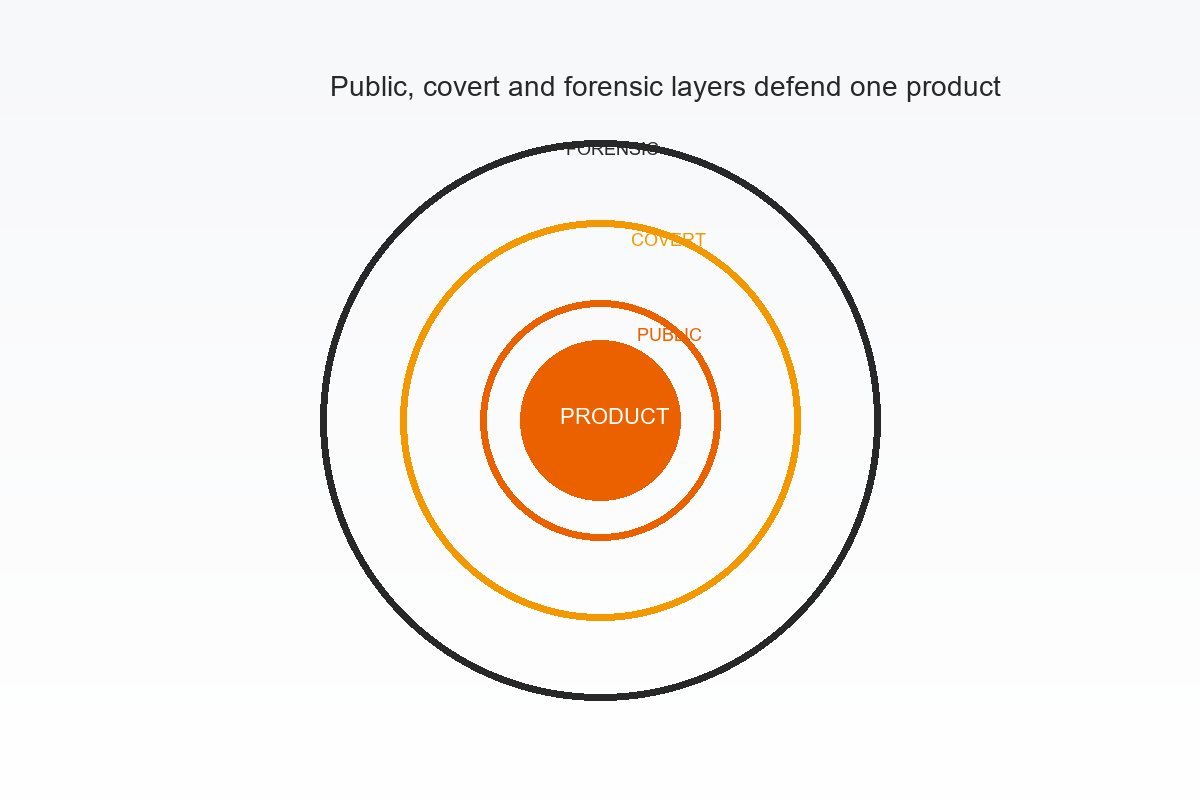
The value is in how the tiers interact, not their sum. A counterfeiter who reprints the overt hologram still lacks the covert UV or hidden code. If they somehow copy that too, the forensic substrate identifies exactly which batch and shift the leak came from. This is the same defense-in-depth logic behind a four-layer program: a visible hologram plus a covert mark plus a forensic tag means no single cloned feature defeats the label. Our layered authentication guide expands the model to include the digital (QR/NFC) layer as well.
Deter the casual fake
Overt effects make replication expensive before a fake is even shipped.
Defeat the cloner
Covert and forensic tiers expose copies that look right to the naked eye.
Prove it in court
Forensic marks supply evidence-grade identification for enforcement.
Choosing the Right Layer Mix
You rarely need all three on every item, but most products should carry at least two. A practical starting point:
- Mid-value consumer goods: public hologram + covert UV is the cost-effective sweet spot.
- High-value, high-risk (pharma, spirits, auto parts): all three tiers, with forensic as the legal backstop.
- Supply-chain and gray-market control: add a digital layer (dynamic QR or NFC) so scans are validated server-side. Our crypto-anchor guide shows how to bind a physical tag to a tamper-evident log.
How We Make Them: The Original Optical Line
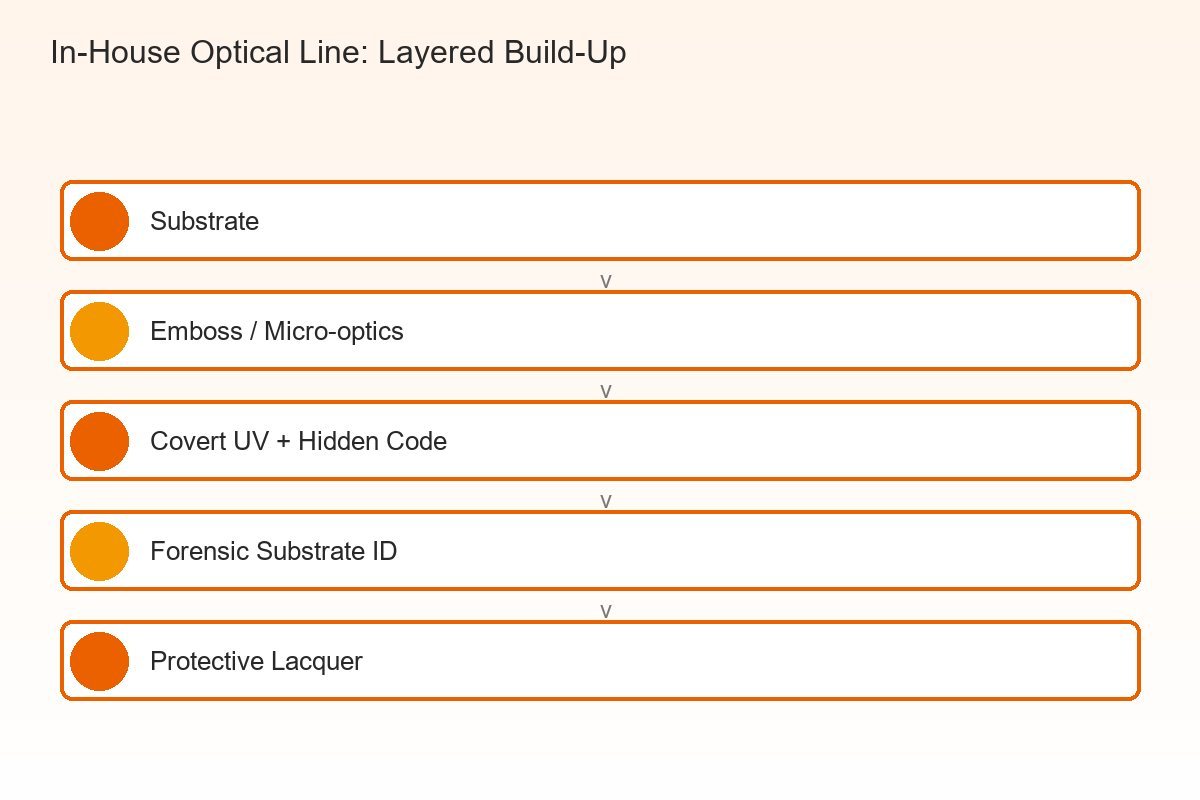
At QSDEFENDER we run an in-house embossing and micro-optical production line, so the master tooling, registration, and hidden-code embedding stay under one roof. That vertically integrated control is itself a security advantage: the covert and forensic structures cannot leak through an outside converter. The image below is a schematic of our layered-label build-up, from substrate to top-protective lacquer.
Frequently Asked Questions
Are holograms unbreakable?
No single feature is. A hologram is strong on overt deterrence but can be reprinted by capable shops. That is why public, covert, and forensic tiers are combined, and why many programs add a digital layer on top.
What is the "hidden code" in micro-optics security?
It is a machine-readable structure embedded inside the hologram that is invisible to the eye and readable only by a compatible scanner. It is the covert tier's digital bridge, similar to the "micro-optics plus hidden code" approach used by leading suppliers.
Can I start with one tier and add later?
Yes. Many programs begin with a public hologram plus a covert UV mark, then add forensic or digital tiers as volumes and risks grow. Start where the counterfeit gap is worst.
How does this relate to QR or NFC?
QR and NFC are the digital tier. A hologram handles the physical tiers; a validated digital code closes the loop with live verification. Our QR implementation playbook covers the digital side in depth.
Putting It Together
A hologram security label is best understood as three layers — public, covert, and forensic — working together. Pick the tiers your counterfeit risk and unit value justify, keep the covert and forensic structures inside your own production control, and consider adding a digital layer for live verification. The full series lives in the Anti-Counterfeiting Technology hub, and our engineers can map the right layer mix to your product lines.
Want a sample catalog? A short review of your product lines against these three tiers usually shows one or two gaps worth closing first. Request a hologram sample catalog and we will send layered-label samples built on our own optical line.