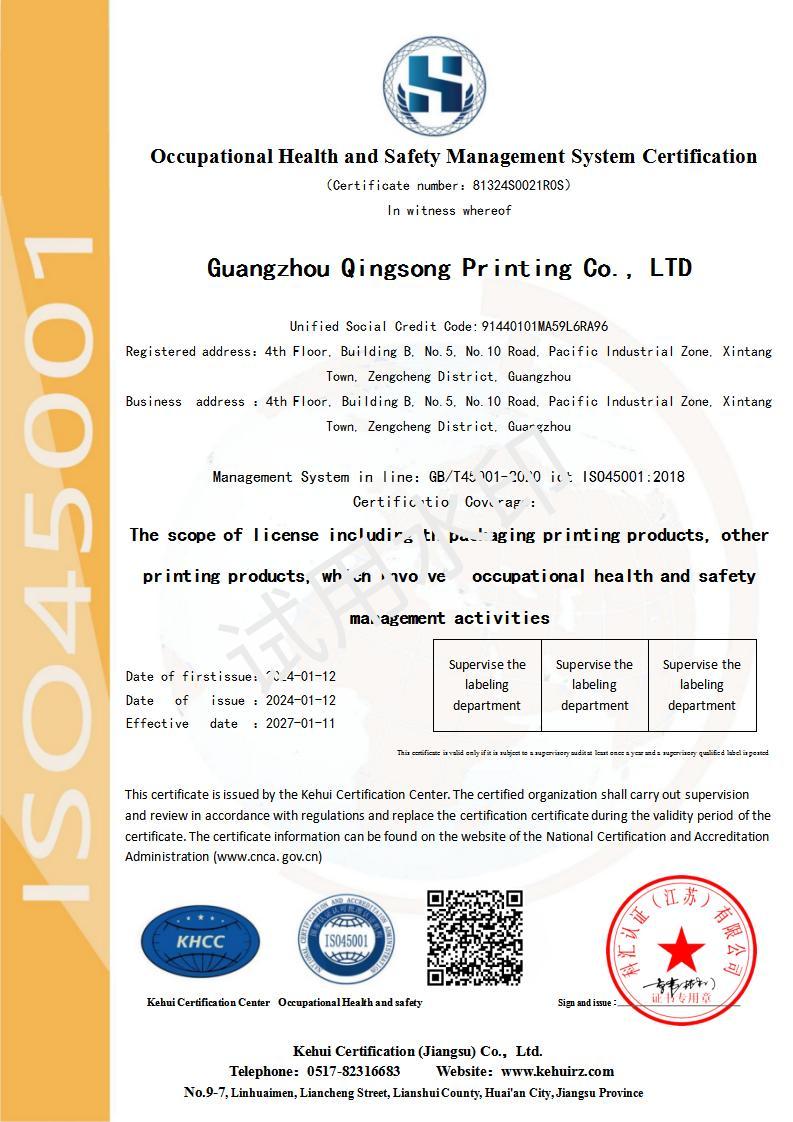
ISO45001
Item specifics
- Expiration Date
- 2024/1/12 - 2027/1/11
- No.
- 81324S0021R0S
- Certification bodies
- Kehui Certification(Jiangsu)Co.,Ltd.
Certificate description
ISO 45001 Certificate Description for the Anti-Counterfeiting Label Industry
1. Overview of ISO 45001
ISO 45001 is an international standard for occupational health and safety management systems, officially titled “ISO 45001:2018 Occupational Health and Safety Management Systems – Requirements with Guidance for Use.” Published by the International Organization for Standardization (ISO) in 2018, this standard aims to help organizations establish a systematic framework to prevent workplace injuries and health issues, enhance employee safety and well-being, and ensure compliance with global occupational health and safety regulations.
Replacing the earlier OHSAS 18001 standard, ISO 45001 adopts the ISO High-Level Structure (HLS), aligning its structure with other ISO standards such as ISO 9001 and ISO 14001. This facilitates the integration of multiple management systems. The standard is applicable across various industries, particularly those with high risks, such as manufacturing, construction, and chemical industries.
2. Background of the Anti-Counterfeiting Label Industry and ISO 45001 Applicability
The anti-counterfeiting label industry, a key segment of modern manufacturing, involves processes like printing, material processing, chemical handling, and machinery operation, all of which present occupational health and safety challenges. Potential risks in this industry include:
Chemical Exposure: Inks, adhesives, and solvents may pose risks to workers’ skin and respiratory systems.
Mechanical Injuries: Improper operation of printing or cutting machines can lead to accidents.
Ergonomic Risks: Repetitive tasks may cause musculoskeletal disorders.
Noise and Dust: Production environments may generate noise and dust, affecting workers’ hearing and respiratory health.
Implementing ISO 45001 enables anti-counterfeiting label companies to systematically identify, assess, and control these risks, fostering a safety culture, improving employee health, and enhancing market competitiveness.